Surah Al-Bayyinah explained for children, in pictures
The upright religion: worship Allah alone, pray and give
Meaning from Tafsir Al-Muyassar, simplified for children. Reviewed by Sherif Alkady, 16 October 2026.
The lessons
 1 · Verses 1–3
The clear sign
Those who disbelieved among the People of the Scripture and the idol-worshippers would not leave their disbelief until the clear sign they were promised came to them: a Messenger from Allah, Muhammad, peace be upon him, reciting pure pages with true news and just commands that guide to the truth.
 2 · Verses 4–5
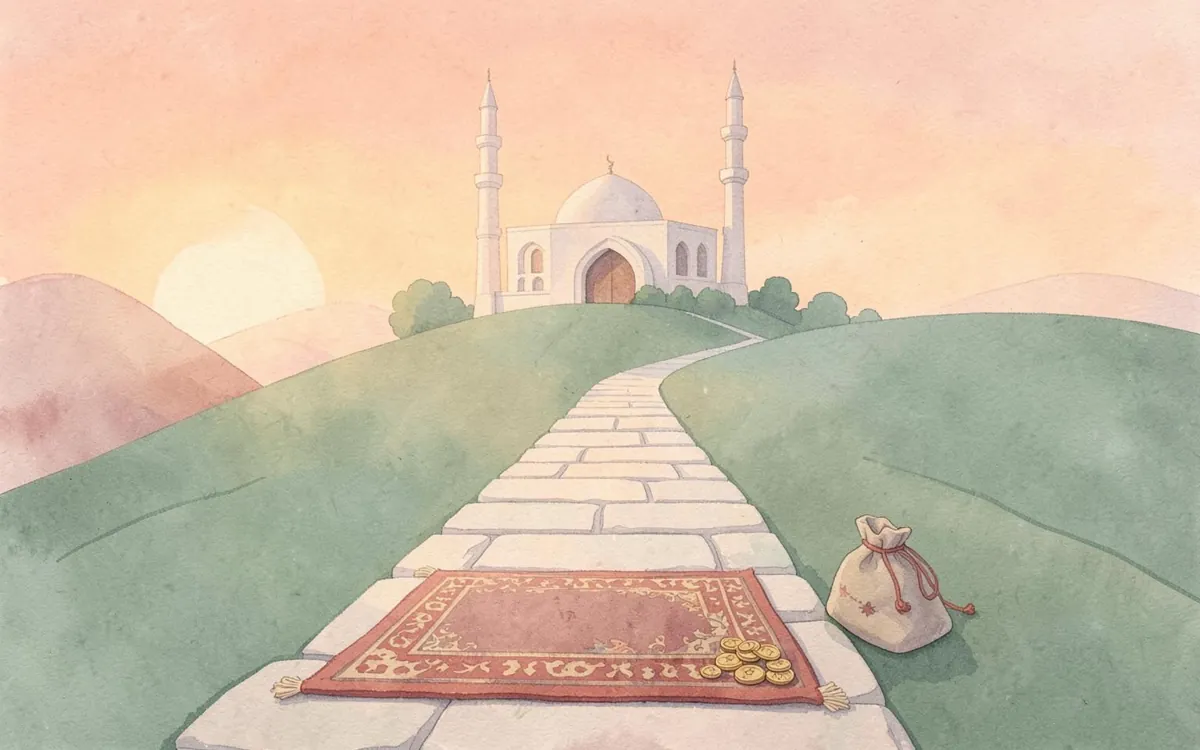
The upright religion
The People of the Scripture did not disagree about Muhammad, peace be upon him, until after they knew he was the promised prophet. And they were only commanded to worship Allah alone, sincerely, to establish prayer and to give zakah. That is the upright religion.
 3 · Verses 6–8
The best of creation
Those who disbelieved will be punished in the Fire of Hell forever; they are the worst of creation. But those who believe and do good deeds are the best of creation, and their reward with their Lord is gardens with rivers flowing beneath, forever. Allah is pleased with them and they with Him.
Surah Al-Bayyinah at a glance
Surah Al-Bayyinah is a Madani surah with 8 verses; it is number 98 in the mushaf, in juz 30 (Juz Amma), and starts on page 598.
- Order in the mushaf
- 98
- Number of verses
- 8 verses
- Makki or Madani
- Madani (revealed in Madinah)
- Juz
- 30 (Juz Amma)
- Starts on page
- 598
- What its name means
- Al-Bayyinah is the clear proof that leaves no doubt: the Messenger ﷺ reciting the Quran.
Classification, verse count and page numbers follow the Madinah Mushaf (Hafs from Asim, Kufi count).
Word meanings in Surah Al-Bayyinah for kids
Meanings from Tafsir Al-Muyassar, in simple words.
- أَهْلِ ٱلْكِتَٰبِ
- the People of the Book (Verse 1)
- مُنفَكِّينَ
- leave their disbelief (Verse 1)
- ٱلْبَيِّنَةُ
- the clear proof (Verse 1)
- صُحُفًۭا مُّطَهَّرَةًۭ
- purified pages (Verse 2)
- كُتُبٌۭ قَيِّمَةٌۭ
- upright writings (Verse 3)
- تَفَرَّقَ
- divided (Verse 4)
- مُخْلِصِينَ
- sincere to Him (Verse 5)
- حُنَفَآءَ
- turning away from all false gods (Verse 5)
- دِينُ ٱلْقَيِّمَةِ
- the upright religion (Verse 5)
- شَرُّ ٱلْبَرِيَّةِ
- the worst of creation (Verse 6)
- خَيْرُ ٱلْبَرِيَّةِ
- the best of creation (Verse 7)
- جَنَّٰتُ عَدْنٍۢ
- gardens of lasting stay (Verse 8)
- خَشِىَ
- fears (Verse 8)
Check your understanding of Surah Al-Bayyinah: questions for kids
Read the question, think, then tap the answer you choose.
1. What clear sign were the People of the Book promised?
2. What does the Messenger ﷺ recite, as the surah says?
3. What were people commanded, as the surah says?
4. Who are «the best of creation», as the surah says?
5. What flows beneath the believers' gardens?
6. What does the surah say about Allah and the believers?
Questions parents ask
What is a simple explanation of Surah Al-Bayyinah for children?
Al-Bayyinah is the clear sign: a Messenger from Allah, Muhammad, peace be upon him, reciting pure pages that guide to the truth. People were only commanded to worship Allah alone, sincerely, to establish prayer and give zakah. Those who believe and do good deeds are the best of creation; Allah is pleased with them and they with Him.
What is «the upright religion»?
It is the straight religion: to worship Allah alone, sincerely, to establish prayer and to give zakah.
What is the lesson of Surah Al-Bayyinah?
That the upright religion is to worship Allah alone, pray and give zakah. Those who believe and do good deeds are the best of creation, and their reward is gardens with rivers flowing beneath.
Why is Surah Al-Bayyinah called by this name?
Al-Bayyinah is the clear proof that leaves no doubt: the Messenger ﷺ reciting the Quran.
What are the main facts about Surah Al-Bayyinah?
Surah Al-Bayyinah is a Madani surah with 8 verses; it is number 98 in the mushaf, in juz 30 (Juz Amma), and starts on page 598. Its big idea: The upright religion: worship Allah alone, pray and give.
Surahs close to Surah Al-Bayyinah
Surahs with a close idea, to carry the journey on.